- Home
- Herb Profiles
- Dandelion
Dandelion
Today, Dandelion is most often dismissed as a nuisance to lawn cultivators or reduced to a wish-making toy for children. Yet it is one of the most widely used medicinal plants in the world, with a long history in European, Chinese, and Indigenous herbal traditions as a nutrient-dense and therapeutically versatile ally.
Despite society’s persistent efforts to eradicate Dandelions from our lawns, they continue to thrive and can often be found pushing up through cracks in the pavement. The way Dandelion exists in the world reveals much about what it has to offer us. It teaches resilience, helping to restore, strengthen and support the body even in the face of environmental pollutants that compromise our internal ‘soil’, or foundation.
Traditional uses include the treatment of digestive disorders such as poor appetite, constipation, indigestion, irritable bowel syndrome, biliousness and nausea; liver and gallbladder conditions including cirrhosis, hepatitis and gallstones; and toxic states associated with intestinal congestion, such as certain skin and autoimmune conditions. Dandelion has also long been used as a general detoxifying agent.
The bitter compounds found in Dandelion root stimulate a reflex response that increases bile production in the liver and promotes bile flow from the gallbladder. As a result, Dandelion root functions as a gentle laxative and digestive aid. Bile plays a crucial role in the digestion of fats and supports overall digestive efficiency. Through its combined actions on the liver and bowel, Dandelion root is highly valued by Herbalists for supporting detoxification throughout the entire body.

Botanical name:Taraxacum officinale
Common name: Blowball, Wild Endive, Fairy clock, Lion’s tooth
Part used: Root, Leaves
Frequently Asked Questions
What is Dandelion good for?
Medicinally, Dandelion is best known for supporting digestive health, liver function and kidney elimination. It stimulates bile production, which aids fat digestion and helps the liver process waste more efficiently. This makes it useful for sluggish digestion, bloating and feelings of heaviness after meals.
Dandelion is a gentle detoxifier, supporting the body’s natural elimination pathways. It is commonly used in spring tonics to help the body transition after winter.
Nutritionally, dandelion leaves are rich in vitamins A, C, K and B-complex, as well as minerals such as potassium, calcium, iron, zinc and magnesium. These nutrients support bone health, immune function and electrolyte balance.
Traditionally, Dandelion has been used to:
- Support skin conditions including eczema and acne
- Reduce water retention
- Encourage appetite and digestion
- Provide anti-inflammatory and anti-arthritic effects
What are the medicinal differences between Dandelion root and Dandelion leaf?
While both parts come from the same plant, Dandelion root and leaf have distinct medicinal actions.
Dandelion leaf acts primarily as a diuretic. It increases urine output, helping the body eliminate excess fluid and metabolic waste. Unlike pharmaceutical diuretics, Dandelion leaf is high in potassium. Which helps prevent electrolyte depletion. This makes it useful for mild fluid retention, bloating and urinary support.
Dandelion root works mainly with the liver and digestive system. It stimulates bile production and supports liver detoxification. It is a mild laxative and supports healthy gut bacteria due to its inulin content.
In summary:
- Leaf: diuretic, kidney-supportive, energetically cooling
- Root: liver-supportive, digestive-stimulant, energetically grounding
Which part of Dandelion has the highest concentration of active constituents?
The root typically contains the highest concentration of medicinally active compounds, particularly those involved in liver support and digestion. This includes sesquiterpene lactones, phenolic acids, inulin, flavonoids and triterpenes.
The leaves are more nutritionally dense, especially in vitamins and minerals and it is recommended to eat the leaves whole to receive their nutritive benefits.
Each part of Dandelion has value, ‘strongest’ depends on the intended use.
What are the active constituents in Dandelion?
Sesquiterpene lactones (taraxacin and taraxacerin)
- Bitter compounds that stimulate digestion and liver function.
Inulin
- A soluble type of fibre that functions as a prebiotic to feed beneficial bacteria in the gut.
Flavonoids (luteolin and quercetin)
- Luteolin and quercetin inhibit inflammatory enzymes, reduce oxidative stress, modulate the immune response and slow the release of histamine. Making them useful in inflammatory, rheumatic and allergic conditions.
Phenolic acids (chicoric, chlorogenic and caffeic acids)
- Phenolic acids afford Dandelion its antioxidant and anti-inflammatory properties. Neutralising free radicals, reducing oxidative stress and inhibiting inflammatory pathways such as NF-κB.
Triterpenes (taraxasterol)
- Taraxesterol inhibits the inflammatory response, reducing levels of pro-inflammatory cytokines such as TNF-α and IL-6.
- Triterpenes protect the liver against damage from harmful substances by modulating oxidative stress and inflammatory pathways.
Vitamins (A, C, K and B-complex)
- Collectively support immune function, bone health and energy production.
- Their high antioxidant content helps protects cells from damage.
Minerals (potassium, iron, calcium, magnesium and zinc)
- Collectively support electrolyte balance, detoxification, bone health, immune function and lowered blood pressure.
What do Dandelions symbolise?
Dandelions have symbolic meanings across cultures. They typically represent resilience, survival and adaptability, as they thrive in harsh conditions where other plants fail.
They are also associated with:
- Wishes and dreams (from blowing seed heads)
- Healing and rejuvenation
- Transformation and renewal
- Hope and perseverance
- Inner strength and healing
In folklore, Dandelions were seen as messengers of change and served as a reminder that beauty and usefulness can exist in overlooked places.
Can I eat Dandelions from my yard?
Yes, provided they are chemical-free. Dandelion should only be eaten from areas that have not been sprayed with herbicides or pesticides and are not contaminated by roadside pollution.
Young leaves are best eaten raw in salads, while older leaves are more bitter and better cooked. Flowers can be used in teas, fritters, syrups or infused honey. Roots can be harvested, dried and roasted.
It is vital that Dandelion is correctly identified before consuming it. It has a few common lookalikes, namely Hawkweed, Hawkbit and Catsear. A sure way to correctly identify Dandelion is to look for its teethed leaves that point backward towards the base of the plant. These teeth are thought to be likened to lion’s teeth, hence Dandelions name.
How much Dandelion is safe to consume?
- Dandelion leaf
- Infusion using dried leaf: 4-10 g/day
- Fluid extract 1:1: Between 1.5-6 mL/day
- Dandelion root
- Decoction using dried root: 2-8 g/day
- Fluid extract 1:2: Between 3-6 mL/day
- Dandelion whole plant
- Fluid extract 1:1: Between 3.5-8.5 mL/day
Always follow dosage recommendations and consult with a Naturopath or Medical Herbalist if using other medications or herbal products.
Why do I pee so much after drinking Dandelion tea?
Dandelion leaf is a natural diuretic. Meaning it increases urine production by encouraging the kidneys to release excess fluid. This is a normal and expected effect.
Unlike many diuretics, Dandelion helps replace lost potassium due to its mineral content. This is why it often considered a gentler option for fluid balance.
Is Dandelion safe during pregnancy?
Dandelion consumed in food amounts is safe during pregnancy. Consumption of Dandelion fluid extractduring pregnancyshould be guided bya Naturopath or Medical Herbalist, for safe dosing and monitoring.
Who should avoid taking Dandelion?
Dandelion may not be suitable for everyone. Those who should avoid or use caution include:
- People allergic to plants in the Asteraceae (daisy) family
- Individuals with gallstones, cholecystitis or bile duct obstruction
- People taking diuretics
- Those with chronic kidney disease
Are there any poisonous Dandelions?
Dandelion (Taraxacum officinale) is not poisonous. It can, however, be confused with similar-looking plants such as Catsear, Hawksbeard and Hawkbit, which are generally non-toxic but may not share the same medicinal properties.
Accurate identification is essential when foraging. The botanical features to look for when identifying Dandelion are:
- Teethed leaves that point backward towards the base of the plant
- When the flower stem is broken, it should produce a milky-white sap
- The leaves are hairless
- The taproot is thick and sturdy, and covered by a dark-brown bark
Where does Dandelion grow in New Zealand?
Dandelion is widespread throughout New Zealand, growing in:
- Lawns and gardens
- Roadsides
- Pastures and paddocks
- Coastal and inland regions
It thrives from sea level to alpine areas and is well adapted to New Zealand’s climate.
How do you grow Dandelion in New Zealand?
Dandelion is easy to grow. It prefers:
- Full sun to partial shade
- Well-drained soil
- Moderate watering
Seeds can be directly sown into the garden. Once established, dandelion is hardy and low-maintenance.
When is the best time to plant Dandelion in New Zealand?
The best time to plant dandelion in New Zealand isearly spring or autumn,when soil temperatures are mild and moisture is more consistent.
When is the best time to harvest Dandelion in New Zealand?
- Leaves: Spring, before flowering, when they are tender and less bitter
- Flowers: Late spring to early summer, fully open
- Roots: Autumn to early winter, when energy is stored in the root
Harvesting at the right time ensures maximum nutritional and medicinal value.
References
Fan, M., Zhang, X., Song, H., & Zhang, Y. (2023). Dandelion (Taraxacum genus): A review of chemical constituents and pharmacological effects. Molecules, 28(13), 5022. https://doi.org/10.3390/molecules28135022
Li, Y., Chen, Y., & Sun-Waterhouse, D. (2022). The potential of dandelion in the fight against gastrointestinal diseases: A review. Journal of Ethnopharmacology, 293, 115272. https://doi.org/10.1016/j.jep.2022.115272
Yan, Q., Xing, Q., Liu, Z., Zou, Y., Liu, X., & Xia, H. (2024). The phytochemical and pharmacological profile of dandelion. Biomedicine & Pharmacotherapy, 179, 117334–117334. https://doi.org/10.1016/j.biopha.2024.117334
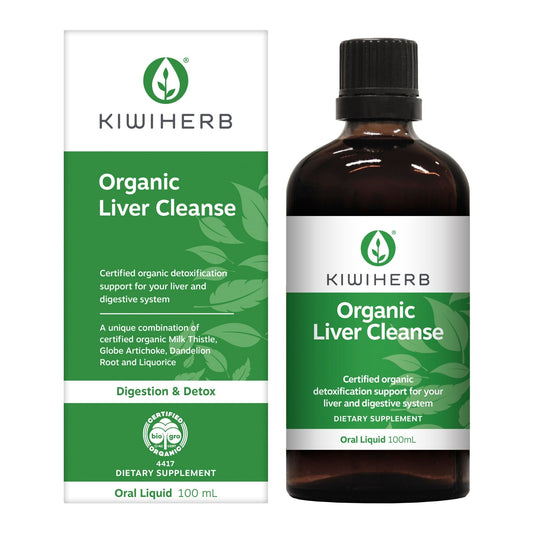
Discover the Kiwiherb products with Dandelion
-
Organic Liver Cleanse
5.0 / 5.0
(10) 10 total reviews
Regular price $66.50 NZDRegular priceUnit price / per